Simulating Behaviour of Extreme Moisture Content Materials with Combined SPH & DEM Modelling
Technical paper prepared by Liam Withey, Shaun Reid, and Daniel Ausling for the 15th International Conference on Bulk Materials Storage, Handling and Transportation, July 2026, Fremantle WA.


Abstract
As high-grade materials become increasingly scarce and mining operations shift toward more challenging mineral bodies, material handling issues are becoming more prevalent. More efficient methods to model such materials will significantly aid in derisking material handling designs. Although extensive research has been devoted to developing models that describe bulk material interactions in Discrete Element Method (DEM) simulations, these models often fall short when applied to highly cohesive or moisture-rich materials. Some research has found success by combining different contact and cohesive models to combine their strengths, but such approaches have limitations in their application to industrial processes.
This paper documents a coupled Smooth Particle Hydrodynamic (SPH) and DEM approach utilised by Agilitus to capture the behaviour of dewatered coal tailings, for the design of a storage bin. It explores the methodology used to calibrate and model material flow and derisk bin design in the absence of previous designs operating with this type of material. The outcomes and lessons learned have been highlighted, reinforcing the importance of further development of modelling approaches to meet the needs of minerals operations that face challenging material handling conditions.
1. Introduction
The mining industry is increasingly confronted with the dual challenge of declining ore grades and the need to process more complex mineral bodies. As operations push into these more demanding environments, difficulties associated with handling problematic bulk materials have become significantly more common. Designing reliable material handling systems for such materials requires modelling approaches that can accurately capture their behaviour, particularly when conventional assumptions about flowability and cohesion no longer hold.
DEM simulations have become a widely adopted tool for predicting bulk material interactions and informing equipment design. However, despite substantial research progress, current widely used DEM models often struggle to represent the behaviour of highly cohesive or moisture-rich, fine-grained materials. Attempts to enhance predictive capability by combining multiple contact or cohesive models have shown promise in controlled studies, such as the work by Carr [1] et al, yet these methods have not been widely adopted within industry.
In response to these challenges, this paper presents a coupled SPH and DEM modelling framework used by Agilitus to simulate the flow behaviour of dewatered coal tailings. This material can exhibit extreme cohesion, but can also fluidise and flow similar to a slurry, depending on the specific moisture content and handling characteristics. This makes it particularly difficult to characterise using traditional modelling techniques. The coupled approach was employed to support the design of a storage vessel in the absence of prior operational benchmarks, requiring a robust calibration methodology and careful validation of predicted flow behaviour.
The work documented here outlines the calibration process, modelling strategy, and design insights gained through the application of the SPH–DEM coupled modelling. The outcomes highlight the potential applications of this approach, while underscoring the current limitations and the need for continued development of predictive tools that can better support material handling design in modern minerals operations.
2. Calibration
Due to the high variability of behaviours that the material exhibits, it was important to gather as much data as feasible to calibrate the coupled model. Laboratory-scale testing was conducted in the TUNRA Bulk Solids laboratories at the University of Newcastle. Small-scale testing was also completed at the mine site. Using these results and the behaviour of the material during existing operations – currently the material is just conveyed to a tailings stockpile – a representative envelope of material parameters was identified.
TUNRA also conducted calibration in tandem with Agilitus to further validate the models. This calibration was detailed by Grasser et al [2], but is also explained in this paper for completeness. Initial laboratory testing included dynamic angle of repose testing and an extrusion test. The setup for these tests is shown in Figure 1.


These tests were used to align the coupled simulations to the material behaviour. The results of this phase of calibration are shown in Figure 2.


To provide additional calibration data, onsite testing was conducted using a sample from the existing plant. A scale model bin was developed to test two different hopper half-angles. The scale model bin used for testing is shown in Figure 3.


The samples tested during this phase exhibited less flowability than was expected based on current operations. Figure 4 contrasts the material discharge from the small-scale bin with an image of the same material as observed on site at the tailings stockpile. The tested material exhibited high cohesive strength, with the material building an asymmetrical cone on discharge, while the on-site behaviour is far more fluidised. The material sample used in the on-site testing was not controlled or tested, and was stockpiled for days before the test was conducted. It is expected that the different material behaviour observed is a result of changes to the moisture content.


This formed the basis for the operating envelope of material conditions used to design around the dewatered tailings. The material can present with extreme cohesion, requiring careful consideration of hopper half-angles and opening dimensions. It can also be highly fluidised and discharge rapidly with excessive splashing and spillage, which was observed on-site during general operations and at similar sites with an operating dewatered coal tailings bin. The final calibration simulation of the higher cohesion model is shown in Figure 5.

3. Full-Scale Bin
Outlet size, hopper half angles, and overall bin height and diameter are usually the key parameters in bin design. In this case, these were constrained by the varied material properties expected of the dewatered tailings and the waste rock that was also loaded into the bin.
The client required a design maximum lump size of 300 mm, which represented the upset condition of an upstream sizer not being operational. To avoid mechanical arching, the outlet was designed at 1500 mm—allowing a 5:1 ratio to the particle topsize. As this was over four times larger than the outlet diameter from the small-scale tests, cohesive arching was unlikely, and excessive discharge with the more free-flowing dewatered tailings was more likely.
The hopper half angles were governed by the high cohesive properties that were observed during testing. A two-stage hopper was designed to manage this cohesion against the bin walls, while maximising the overall usable volume within the bin.
Managing the above constraints with the volume requirements, the final bin design was relatively tall and slender. To manage the quaking risks associated with this style of bin, an insert was used at the ring beam level on the bin. It also protects the gate from impacts and high material pressures. Additional lower inserts were also considered to aid in this regard, but it was agreed that these would be considered after commissioning, when the flow through the full-scale bin was better understood.
4. Simulations
Scaling the simulations to the full-sized bin provided additional technical challenges. Previous simulations of the scale testing from site required 4-8 hours to solve, the full-sized bin using the previously calibrated material particle sizes solved 1 second of simulation every 32 hours, requiring two weeks for a 10-second simulation. TUNRA continued to simulate the full-scale bin using these parameters, which provided a reliable result representing the high-cohesion end of the design envelope but required a total of 4 weeks to solve.
As several simulations were required to test various design iterations, a more reasonable solve time was required. Considering the data available from the laboratory and field calibration, the particle size was increased and recalibrated. This calibration targeted the more free-flowing behaviour experienced on site, and similar operations using belt-press dewatered tailings bins. Figure 6 shows the calibrated full-scale, free-flowing material discharging into the receiving haul truck.

The final simulations conducted by TUNRA are shown in Figure 7. The results of this simulation indicated a low likelihood of cohesive arching, and the more likely issue would be material spillage/splashing. To manage this, the discharge area was covered with plate steel as well as design and implementation of strict safety and operational systems at the required Safety Integrity Level (SIL) levels. Access to this area could then be limited to prevent falling object hazards and enable a localised area for washdown, simplifying the maintenance task. This is highlighted in Figure 8.


An additional concern was how the characteristics of the dewatered tailings would impact the material-induced pressure on the bin, and how best to address the structural design with this in mind. It was not well understood whether the material would behave as a traditional bulk material and exhibit arched stress fields, or whether it would present more hydrostatically under certain conditions.
Baseline pressures were calculated using the approach illustrated in AS3774, combined with the modified flow method proposed by Roberts [3]. Using this approach, the worst-case loading scenario was if the bin was full of waste rock due to its higher bulk density when compared to the dewatered tailings. The bin was also designed to suit a completely hydrostatic load in a case where the bin was filled with dewatered tailings that presented more like a fluidised slurry than a traditional bulk material. The normal pressure on the bin walls under these two conditions is shown in Figure 9.

By designing for these worst-case conditions, which did not include the insert at the main ring beam, the design team was satisfied that the design would hold up to any of the expected service conditions. Additional simulations were conducted to analyse the bin loads and test the validity of the modelling approach for such an application.
The pressures were discretised into 500 mm high rings up the bin and averaged to minimise the noise in the results arising from how the geometry was meshed. The combined normal pressures from the DEM and SPH elements under filling and flow conditions are shown in Figure 10. These simulated loads correlated well with the AS3774 predictions when treating the dewatered tailings as a granular material, but material settling at the start of the simulation resulted in arched stress fields in the initial fill case.
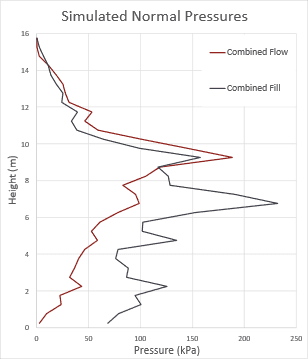
When these loads were separated into their constituent DEM and SPH elements, the results showed a clear deviation between the loading caused by each model – see Figure 11. The pressure distribution induced on the bin associated with the DEM particles aligned with traditional bulk material simulations, while the SPH elements imparted a hydrostatic pressure distribution on the bin. This could be a result of the Newtonian fluid SPH model used for this analysis.

A study by Wu et al [4] modelling mineral slurries using coupled DEM and SPH showed that the non-Newtonian Power-law SPH model reflected better correlation than the Newtonian model with rheology testing of a copper slurry between 30% and 80% concentration. Although the dewatered coal tailings are not a mineral slurry, this non-Newtonian approach may result in a more accurate representation, but further research and testing are required to confirm.
Another possible factor is the size ratio between the DEM and SPH elements. The technical documentation for ANSYS Rocky suggests a ratio of SPH element size to the minimum DEM particle size of 3:1, and this has been used throughout this analysis. A paper by Zhou et al [5] exploring the use of an SPH-DEM coupled method applied to a landslide tsunami highlighted the impact this ratio can have on the accuracy of the simulation. They found that loose particle assemblies should have a ratio smaller than 20:1, while in dense particle assemblies, a ratio smaller than 6:1 provided good results.
It is also possible that the current pitfalls with the coupled approach used within this project—such as the surface tension models used for the SPH elements not being applied to SPH-DEM interactions—may not be fundamentally suitable to provide material-induced loads for bin design in its current state. However, it is still able to provide a suitable representation of flow behaviour and is still a useful tool for design. Further research on the applications of coupled DEM-SPH modelling will support the development of fit-for-purpose design when dealing with extreme moisture content materials.
5. Conclusion
The coupled SPH–DEM modelling approach presented in this work demonstrates a viable pathway for simulating the highly variable and complex behaviour of extreme moisture content materials such as dewatered coal tailings. Through a multistage calibration process incorporating laboratory testing, on-site scale trials, and iterative numerical refinement, the modelling framework was able to capture a representative envelope of material responses ranging from highly cohesive, lowflow conditions to more fluidised behaviour. This proved essential in supporting the design of a fullscale storage bin in the absence of prior operational benchmarks.
The application of the coupled method to bin discharge and load prediction highlighted both its strengths and its current limitations. While the SPH–DEM approach provided valuable insight into expected flow patterns, risks of cohesive arching, and operational considerations such as spillage management, discrepancies between predicted and simulated wall pressures indicate that additional development is required to improve its reliability when used for structural load validation. Factors influencing these discrepancies—including SPH rheological model selection, DEM–SPH size ratios, and current constraints in SPH–DEM interaction physics—warrant further investigation.
Despite these limitations, the outcomes of this study reinforce the utility of coupled modelling for derisking material handling designs involving challenging, moisturerich materials that lie beyond the representational capability of traditional DEM. Continued refinement of SPH–DEM methods, supported by targeted experimental validation, will further enable the mining and minerals sector to design fitforpurpose infrastructure for problematic material classes.
References
- [1] Carr, M., Roessler, T., Robinson, P., Otto, H., Richter, C., Katterfeld, A., Wheeler, C., Calibration procedure of Discrete Element Method (DEM) parameters for wet and sticky bulk materials, Powder Technology, Vol. 429, 2023.
- [2] Grasser, D., Reid, S., Bradney, D., Simulation and validation of a highly cohesive paste inside a storage bin, 11th International Conference on Conveying and Handling of Particulate Solids, 2024.
- [3] Roberts A., Basic Principles of Bulk Solids, Storage, Flow and Handling, The University of Newcastle Research Associates (TUNRA), 1998.
- [4] Wu, D., Chen, W., Glowinski, D. and Wheeler, C., Modelling mineral slurries using coupled discrete element method and smooth particle hydrodynamics, Powder Technology, Vol. 364, 2020, pp. 553-561.
- [5] Zhou, Q., Xu, W.J., Dong, X.Y., SPH-DEM coupling method based on GPU and its application to the landslide tsunami. Part I: method and validation, Acta Geotechnica, Vol. 17, 2022.
